How to Delegate Business Operations: A 3-Bucket Audit for Founders

Direct answer: Delegating business operations starts with separating founder-only work from repeatable work that can be documented and handed off. The 3-Bucket Audit gives you a practical way to sort tasks into Keep, Systemize, and Delegate now. It turns operational overload into a clear operating system, one that protects your attention without losing control.
You finish the day busy.
Not productive. Busy.
You answered messages between meetings. Chased a supplier. Moved a call across three time zones. Checked a document that should never have reached you. Then, just before bed, you remembered the one strategic decision you actually needed to make.
That is the residue of running a growing business.
The individual tasks are rarely difficult. The problem is the background processing. Every small task stays open in your head until you close it, delegate it, or forget it.
On 25 August 2026, we hosted a small group of founders in Bali, Uluwatu to share ideas about the best way to delegate business operations.
Before we said anything about what Dayaly Ops does, we asked three questions:
- What is actually eating your time right now?
- If you could hand off one thing today, what would it be?
- What is actually stopping you from letting it go?
Here is what came back.
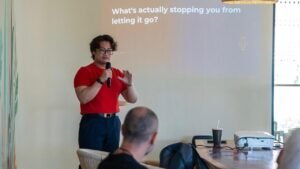
Founders share a delegation challenge during Dayaly Ops’ Uluwatu founders’ session.
What operational problems do founders keep postponing?
The people in the room ran different businesses, came from different countries, and faced different constraints.
But their answers kept landing on the same handful of problems:
- Paperwork that never lets up.
- Coordination across time zones.
- No clear person to hand work to.
- The pressure of being expected to do everything yourself.
- The fear that delegation will create more work before it removes any.
The trap is easy to miss.
Each task feels manageable. A supplier follow-up. A calendar change. A compliance document. A missed call. A quick client update.
But the collection of these tasks becomes a tax on your attention.
Pasha, Russia: Why Paperwork Runs You?: The Hidden Admin Tax on Businesses
Pasha runs several businesses, including agriculture. When we asked what was eating his time, he did not need to think about it.
“What has been eating my time is paperwork that surrounds every project.”
It is a common pattern in regulated, physical industries. The work that generates revenue is only half the job.
Permits need to be checked. Supplier documents need to be collected. Compliance paperwork needs to clear. Someone needs to follow up when a form is incomplete.
None of this is necessarily founder-only work.
But without a clear owner and a repeatable process, it returns to the founder by default.
Jay, United States: How to Manage Global Client Time Zones Without Working 24/7
Jay’s answer split in two directions.
First, AI and data security:
“I want to use a lot of AI for the research stuff, but I was told that if you don’t use a paid version, if you use the free version, anyone else in your field could end up seeing that same research. I don’t want a lot of that knowledge to be out there.”
For a business where research is part of the competitive edge, that is a fair concern. Not an overreaction.
The second issue was time zones:
“My clients are from all over the world, selling product, across a lot of different time zones. My assistant helps me streamline the calls.”
When customers are active while you are offline, responsiveness becomes an operating problem. It cannot depend entirely on your personal availability.
Matthew, Australia: Why Solo Founders Are Always Mentally Drained?
Matthew’s answer was the most direct in the room.
He is a solo founder and author who already understands the problem. He just had not found a practical starting point.
“Right now I’m doing pretty much everything myself. I know that’s not sustainable long-term, I just haven’t figured out where to start with actually delegating.”
The willingness to delegate is already there.
What is missing is a clear first step:
What should you hand off? What should you document? What still needs your judgment?
Ricardo, Italy: New Market Trend from Europe, The Data Says You Should Automate Inspection
Ricardo’s focus was more technical. He is bringing AI into product inspection so items can be checked against requirements automatically instead of manually.
“We’re building automated systems, and part of what we’re trying to do is move stakeholders and clients to a more agile way of working. You want that follow-up, that constant touch.”
He also pointed to the working culture behind the ask. In Europe, the pressure to deliver is constant. Manual checklists cannot keep expanding forever.
The principle applies well beyond product inspection:
Automate what can be automated. Systemize what still needs human ownership. Keep the judgment that only you can provide.
What does the research say about interruptions, delegation, and response time?

The feeling in the room has some useful evidence behind it. The evidence needs to be handled carefully.
Gloria Mark’s research on attention and interruption has shown that recovering from an interruption can take more than 23 minutes in some contexts. The exact recovery time varies by task and environment. The important point is not a universal stopwatch figure.
It is the accumulated cost of switching.
You may only spend two minutes answering a message. The mental residue can last much longer.
Gallup’s study of 143 Inc. 500 CEOs also found an association between strong Delegator talent and business growth. Leaders identified as strong delegators had a reported three-year growth rate of 1,751% and generated approximately 33% more revenue than lower-scoring peers.
That does not prove delegation alone caused the growth. Strong delegation may be connected to other leadership capabilities, business conditions, and company decisions.
It does suggest that a founder’s ability to release operational ownership is not a minor management preference.
Lead response shows a different version of the same problem.
Research associated with James Oldroyd, summarized by InsideSales and discussed by Harvard Business Review, found that contacting an inbound lead within five minutes was associated with 21 times higher odds of entering the sales process than waiting 30 minutes.
Separately, HBR reported that the average response time among companies that responded to an online lead was 42 hours, and that 24% took more than a day.
These studies should not be conflated. But together, they show the cost of an unowned workflow:
Slow response can damage revenue. Constant response can damage your attention.
The solution is not for you to answer everything faster.
It is to build a system where the right work reaches the right person at the right time.
How does the 3-Bucket Audit work?
The 3-Bucket Audit is a simple way to examine the work currently sitting on your plate.
Take the tasks from your calendar, inbox, project board, and weekly routine. Then place each one into one of three buckets.
| Bucket | Use it for | The decision |
|---|---|---|
| Keep | Work that requires your judgment, relationship, or signature | Protect it and keep ownership |
| Systemize | Repeatable work that nobody has documented yet | Write the steps, define the quality bar, then assign ownership |
| Delegate now | Repeatable work where the steps already exist in your head | Hand it off now instead of waiting for perfect documentation |
The distinction matters.
Delegation is not removal.
Delegation means the work still happens, but someone else owns the process.
Removal means the work no longer needs to happen, or can be replaced by automation.
Do not delegate a pointless meeting. Remove it.
Do not automate a sensitive relationship decision. Keep it.
Do not keep processing the same invoice manually because “it is faster if I just do it.” Systemize it, then move it.
Which tasks should a founder keep?
Keep the work that genuinely depends on your judgment, your relationships, or your signature.
That may include:
- Setting company direction.
- Making high-impact product or market decisions.
- Handling critical strategic partnerships.
- Building trust with key customers.
- Making major resource-allocation decisions.
- Protecting company values and culture.
- Approving decisions with material legal or financial consequences.
The test is simple:
If someone else completed the task correctly, would the business still need your judgment?
If yes, keep it.
If not, it may belong in one of the other two buckets.
Keep does not mean “anything important.” Many operational tasks are important. It means the task requires your specific contribution.
What should be systemized before delegation?
Systemize work that repeats but still lives in your memory.
Examples include:
- Client onboarding.
- Vendor follow-up.
- Invoice preparation and tracking.
- Weekly reporting.
- Inbox triage.
- Project-status updates.
- Basic HR administration.
- Meeting preparation.
- Standard customer follow-up.
A useful system does not need to be a 40-page manual.
Start with five things:
- Trigger: What starts the process?
- Steps: What happens next?
- Tools: Where does the work happen?
- Quality bar: What does “done correctly” look like?
- Escalation: When should the owner bring it to you?
This is where many founders get stuck. They think delegation requires a perfect playbook before anyone else can start.
It does not.
Document the current version. Let the owner improve it. Update the playbook as the process becomes clearer.
Progressive clarity is better than permanent founder ownership.
When should you delegate a task immediately?
Delegate now when the task is repeatable and the steps already exist in your head.
You may already know:
- Who needs to be contacted.
- What information needs to be collected.
- Which tool to update.
- What the normal answer looks like.
- When the task is complete.
- What exceptions require escalation.
That is enough to begin.
The task does not need to be glamorous. In fact, the most useful first delegation is often something boring and recurring.
The work you have explained ten times is usually the work that needs a process.
How can an AI receptionist support a business?
Near the end of the session, we showed the group something concrete.
Rachel, Dayaly Ops’ AI receptionist, answered a live call in real time.
She can:
- Respond without putting the caller on hold.
- Qualify leads against defined criteria.
- Book directly into a calendar.
- Send a Slack or email alert.
- Include the transcript and relevant context for the team.

For villas, clinics, studios, and other businesses where a missed call can become a missed booking, this matters.
But Rachel is not the entire operating system.
AI can handle a defined interaction quickly. A human owner still needs to manage exceptions, improve the rules, review context, and make sure the workflow connects to the rest of the business.
Not AI instead of people.
Not people manually doing everything.
A clear handoff between both.
When does a managed operations pod make sense?
A managed operations pod makes sense when your business has recurring operational work, but hiring and managing a full internal team would create too much drag.
The difference is important:
- An AI tool automates a defined task.
- An individual assistant completes assigned work.
- A managed operations pod owns recurring workflows through people, playbooks, tools, quality checks, and escalation paths.
That is the model behind Dayaly Ops’ managed operations pods.
The pod plugs into the tools you already use, including email, Notion, project-management platforms, and shared communication channels. It can support admin and inbox management, vendor coordination, invoicing, project management, light HR, and weekly reporting.
No hiring queue.
No onboarding drag.
No single point of failure when one person is unavailable.
Just a system running quietly in the background.
Why did we run this founder session?

The businesses we work best with do not need convincing that operations are a problem.
They already know.
They are losing time to follow-up. Carrying paperwork into the evening. Becoming the default escalation point. Trying to grow while still functioning as the admin team, project manager, receptionist, and operations lead.
The problem is not always mindset.
Sometimes you are willing to delegate. There is simply no operating system to receive the work.
That is the mental shift:
Not “How do I become better at doing everything?”
But “Which work should remain mine, which work needs a process, and which work should already belong to someone else?”
If you want to apply the exercise to your own business, you can start with the free Dayaly Ops audit tool. You can also read our guide to building a back office that runs without you.
Author POV
Founders often say they need better time management when what they really need is better work ownership.
A longer to-do list will not solve that.
Neither will hiring one person and hoping they can reconstruct six months of undocumented decisions.
Start smaller. Sort the work. Keep the decisions that require you. Give repeatable work a visible owner. Build the process around reality, not an imaginary perfect week.
The objective is not to become unavailable.
It is to stop being required for every small thing.
Want to run your own 3-Bucket Audit? Book a 30-minute discovery call or try the free ops audit tool first.
What will you stop building next quarter if these tasks remain with you?
Dayaly Ops · PT Katalis Daya Insani · Jakarta, Indonesia