The 80/20 Rule of Ops: How to Build a Back Office That Runs Without You
You sit down at your desk with clarity in your eyes and a clean calendar. By noon, you are knee-deep in invoices, vendor follow-ups, and calendar coordination.
The day vanishes. You feel exhausted, yet you produced nothing new.
This is not a productivity failure. It is a structural trap. Every growing business pays an invisible toll. We call it cognitive debt. It is the mental residue left behind when high-value founders spend their working hours wrestling with low-leverage back-office tasks.
If you want to move from frantic hustle to true leverage, you need to understand the 80/20 rule of operations. Not as a vague management theory, but as an architectural blueprint for scaling business operations without burning out your internal team.
The 80/20 Trap of the Back Office
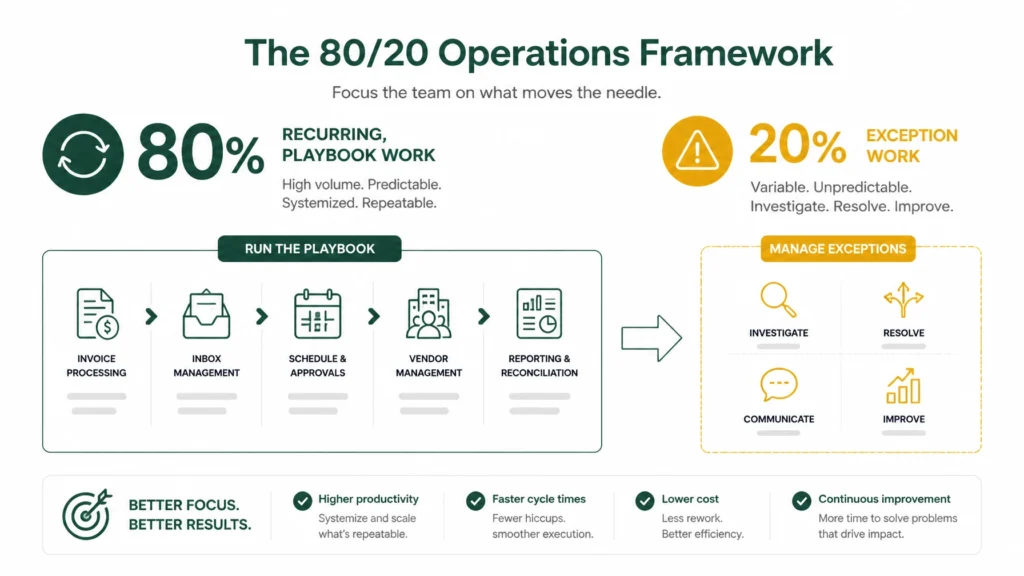
Here is the fundamental truth about your operations: 80% of your back-office tasks are recurring, predictable, and playbookable.
Only 20% require your actual, real-time judgment.
Yet, most founders treat operations as a 100% bespoke emergency room. Every invoice check, every vendor onboarding, every calendar adjustment is handled as if it were a unique snowflake requiring executive intervention.

When you treat repeatable work as ad-hoc friction, you inflate your cognitive load. Your brain becomes a background processor for routine administration. You try to fix it by hiring freelancers or posting job listings, only to realize you’ve just inherited a new management job: babysitting people who need constant direction.
That is why standard approaches fail. You don't need another person to check in on. You need a system that absorbs the noise.
The Gold Standard: The 80/20 Capacity Model
Look inside high-performing teams, and you will find a quiet, predictable rhythm. At Dayaly Ops, our internal capacity model is built entirely on this exact ratio: 80% structured, playbook-driven execution; 20% agile, ad-hoc buffer.
When you look to streamline business operations, this split changes everything:
- The 80% (Playbookable): Inbox triage, recurring invoicing, light HR administration, weekly reporting, and standard vendor coordination. These do not need your creative genius. They need rigid, reliable execution against established playbooks.
- The 20% (Real-Time Buffer): Edge cases, strategic pivots, high-stakes client escalations, and core product decisions. This is where your mind actually belongs.
When your back office is properly configured, the 80% runs quietly in the background. You stop thinking about whether invoices went out. You stop wondering if weekly reports are compiling. The machinery simply hums.
If you are curious how this compares to traditional alternatives, take a look at our breakdown on fractional operations managers versus virtual assistants or explore our free tool to audit your current ops tax.
Delegation vs. Removal
Most business advice tells you to "delegate more."
Wrong. Delegation still requires oversight. Delegation means you are assigning a task while keeping the mental burden of tracking it.
What you actually need is removal.

Not this: Spending two hours every morning writing step-by-step Loom videos for a freelancer who will quit in three months.
Instead, this: Plugging in a ready-to-install remote operations team that arrives equipped with standardized playbooks, integrated directly into your existing tools like Notion and email.
When you plug in a dedicated ops pod, you aren't just hiring extra hands. You are outsourcing the entire operational loop. You hand over the keys to the back office, and you stop receiving status updates about routine tasks. You only hear about things when they cross the threshold of your 20% judgment zone.
The Pod Model as the Natural Implementation
How do you put the 80/20 rule into practice without spending six months writing documentation?
This is precisely why we designed our managed ops pods. Through structured, managed business services, businesses across Southeast Asia, Australia, and the US get immediate access to trained back-office professionals who operate on fixed monthly pricing and pre-tested workflows.
There is no hiring lag. No onboarding guesswork. No micromanagement overhead.
It is a plug-and-play back office designed around the exact mathematical split of high-growth operations: the heavy 80% of routine grind handled by playbooks and pod members, leaving your executive team entirely free to focus on product, growth, and vision.
Author POV
Author POV:
Let’s be completely honest for a second. Most founders over-engineer their operations because deep down, they're terrified of letting go. Managing endless Slack pings feels productive: it feels like being a "busy, hands-on CEO." But it's an expensive vanity metric. Stop treating your inbox like your core product. Plug in an ops pod, let the playbooks do their job, and go build something that actually requires your brain.
Conclusion
The 80/20 rule isn't just about time management. It is about operational architecture. Every hour you spend clearing your own admin queue is an hour stolen from the high-leverage work that only you can do.
Look at your calendar today. How much of it was spent processing the 80% versus driving the 20%?
If the numbers don't match your ambitions, it’s time to stop tweaking your workflow and start removing the grind entirely. What is your current operational setup actually costing your business in missed opportunities?