New Market Trend from Europe, The Data Says You Should Automate Inspection
Aug 2026 · Dayaly Ops · From our Uluwatu founders’ session
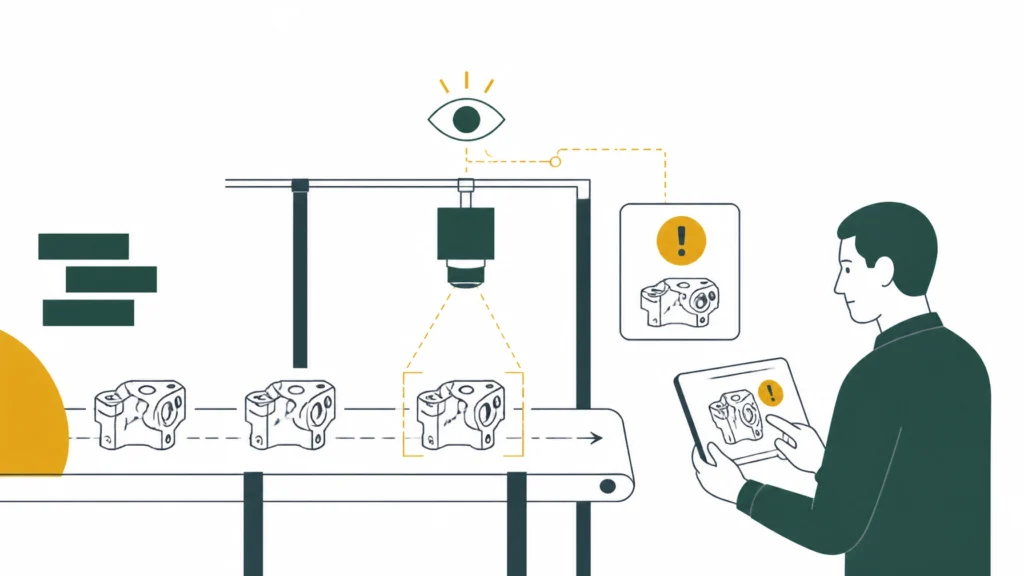
One of the founders in our sharing session, Ricardo, brought a problem that was more technical than the others: bringing AI into product inspection so items can be checked against requirements automatically, freeing his team to spend more time on the constant-touch relationship-building that agile client work demands.
That distinction matters.
Ricardo is not trying to remove people from the quality process. He is trying to remove the repetitive part that keeps people from doing the work only they can do.
The inspection has to happen.
But not every inspection step needs the same kind of attention.
What problem was Ricardo actually trying to solve?

Manual inspection looks manageable when you look at one item.
Check the product. Compare it with the requirement. Mark it as acceptable or not. Move to the next one.
The trap appears in the aggregate.
One check becomes hundreds. Hundreds become every shift, every batch, every product variation. The task remains simple, but the mental burden compounds. Repetition consumes attention. Variability enters through fatigue, inconsistent interpretation, changing conditions, and different levels of experience.
Then there is the work waiting on the other side.
A client needs an update. A specification has changed. A production issue requires explanation. A relationship needs attention. The same people who are supposed to stay close to clients are still comparing products against the same checklist.
This is not a people problem.
It is a capacity problem.
Ricardo’s opportunity is to make the inspection layer more scalable without making the client relationship less human.
Why does manual inspection become harder to scale?
Human inspection has strengths that software does not.
People can interpret context. They can notice something unusual. They can ask whether the requirement itself is still correct. They can make a judgment when the product does not fit neatly into a known category.
But human attention is not unlimited.
A useful example comes from a 2015 Sandia National Laboratories study involving 82 inspectors and 140 precision-manufactured parts. In that specialized study, inspectors correctly rejected 85% of defective items. At the same time, 35% of acceptable parts were incorrectly rejected.
That is not a universal benchmark for every factory or product. It is one controlled research setting.
It does show the underlying tension clearly: inspection decisions involve both missed defects and false alarms. Optimizing one can affect the other.
Sandia’s later 2018 controlled experiment also found that a human-factors-informed inspection process produced higher accuracy, lower workload, and better usability than a control process. The lesson is not “humans fail.” The lesson is that the workflow surrounding human judgment matters.
Better inspection is not only about adding technology.
It is about designing the work so that attention is used where it creates the most value.

What can AI-assisted quality control do well?
AI product inspection is most useful when the task is defined, repeatable, and visible.
That could include checking for:
- Missing or misplaced components
- Incorrect product orientation
- Label or marking errors
- Surface damage
- Inconsistent assembly patterns
- Incorrect routing or positioning
- Presence or absence of a required feature
- Visual differences from an approved reference
The system can review images consistently. It can apply the same criteria across shifts. It can flag borderline cases. It can create a record of what was checked and why an item was escalated.
A 2024 study in Applied Sciences examined AI-based inspection for automotive wire harnesses. On its reported validation setup, the study achieved approximately 99.2% accuracy and 99.4% mean average precision.
That is a useful example.
It is not a universal promise.
Results depend on the dataset, defect types, lighting, camera position, product variation, model design, decision thresholds, and deployment conditions. A model trained on one harness configuration may not perform the same way on another. A system that works in a controlled testing environment may need further calibration on a live production line.
The number is not the product.
The operating conditions are the product.
Is human-plus-AI inspection better than either approach alone?
For many workflows, the strongest model is not manual inspection or AI-only inspection.
It is human-plus-AI inspection.
AI handles the volume. Humans handle the ambiguity.
| Inspection approach | Strengths | Limitations | Best use | What remains with humans |
|---|---|---|---|---|
| Manual inspection | Contextual judgment, flexibility, useful for novel defects | Slower, variable, difficult to scale, attention-heavy | Low-volume work, early-stage processes, unusual or changing products | All inspection, interpretation, escalation, and documentation |
| AI-assisted inspection | Consistent screening, repeatable checks, fast image review, traceable decisions | Depends on data and conditions; can create false positives or miss unfamiliar defects | Stable, visible, repetitive quality checks | Threshold decisions, exception review, process changes, non-visual checks |
| Human-plus-AI inspection | Combines speed with judgment; supports continuous learning | Requires clear ownership, review rules, and ongoing monitoring | Scaled workflows where defects are defined but exceptions matter | Ambiguous cases, novel defects, approval, escalation, client communication |
The practical division is straightforward.
AI should not be asked to make every decision.
It should be asked to make the decisions it can make reliably, then show its uncertainty clearly.
A human should review the cases that carry higher risk, lower confidence, or greater ambiguity. The review process should also feed new examples back into the system so it improves over time.
That is not delegation in the loose sense of “handing work away.”
It is removal of unnecessary repetition, followed by deliberate ownership of the decisions that remain.
What should you define before collecting inspection data?
Start with the requirement.
Not the model. Not the camera. Not the software subscription.
Write down what “acceptable” means.
Separate the requirements into three groups:
- Clearly visible defects that a camera may identify.
- Ambiguous conditions that require human review.
- Non-visual quality checks that need another test or process control.
For an automotive wire harness, for example, image inspection may help identify routing, connector orientation, labels, or visible insulation damage. It cannot, by itself, confirm every aspect of conductor integrity, crimp strength, continuity, or electrical performance.
That boundary needs to be explicit.
Otherwise, automation creates false confidence instead of reliable quality control.

How should a business implement AI product inspection?
A practical implementation framework looks like this:
1. Define the requirements
List the defects, variations, and acceptance criteria. Decide which outcomes are pass, fail, or review. Define the cost of a missed defect versus a false rejection.
2. Collect representative images and data
Use images from real operating conditions, not only ideal examples. Include different product variations, lighting conditions, angles, materials, and defect severity.
The dataset must represent the work the system will actually see.
3. Establish human review thresholds
Decide when the system can approve an item, when it should flag one, and when a human must review it. Higher-risk decisions should generally have stricter review rules.
4. Test false positives and false negatives
Do not measure only overall accuracy. Track what the system misses and what it incorrectly rejects.
A false negative may allow a defect through. A false positive may create unnecessary rework, delay, or scrap. Both have operational consequences.
5. Pilot one workflow
Choose one defined inspection process. Keep the scope narrow enough to learn quickly. Compare the AI-assisted workflow with the current process before expanding it.
6. Monitor and improve
Review escalations, misses, false alarms, process changes, and new product versions. Assign an owner for threshold changes, data updates, and reporting.
Without ownership, an inspection model slowly becomes disconnected from the operation it was built to support.
What does this have to do with scaling business operations?
Ricardo’s example is technical, but the operating principle is broader.
You do not scale by automating everything.
You scale by separating repeatable work from judgment-heavy work.
You automate the defined layer. You protect the human layer. You create clear review, escalation, and reporting paths between them.
The same logic applies outside manufacturing.
A managed operations team may automate a recurring report, standardize an approval workflow, or route an exception to the right person. But the system should not silently make a judgment that belongs with the founder, client lead, or subject-matter expert.
Dayaly Ops is not a specialist industrial machine-vision vendor. We do not install inspection cameras or build factory models.
Our role is the operating layer around recurring work: defining the workflow, assigning ownership, documenting the playbook, managing exceptions, and reporting what happened.
That is where many automation projects become fragile.
The tool works. The process does not.
Ricardo’s lesson is more useful than a claim that AI can replace quality teams. It is this:
Automate defined, repeatable work. Keep human judgment for ambiguous and relationship-critical decisions. Then build the operating system that connects the two.

What should Ricardo: and other founders: do next?
Start with one inspection workflow that consumes time but follows a stable pattern.
Document the requirement. Gather real examples. Identify the decisions that still need a person. Define what happens when the system is uncertain.
Then measure the result in operational terms:
- How much review time was removed?
- How many defects were detected earlier?
- How many false alarms were created?
- How quickly were exceptions resolved?
- Did the team regain time for client communication?
- Who owns the workflow when the product or requirement changes?
The goal is not a more impressive dashboard.
The goal is more available attention.
Penny’s Take: The best automation does not make people disappear. It makes it harder for important human work to be buried under work that never required a human in the first place.
Read more about the founders and the 3-Bucket Audit from our Uluwatu session → How to Delegate Business Operations: A 3-Bucket Audit for Founders
If you are trying to identify which recurring workflows should be automated, delegated, or kept with you, book a 30-minute discovery call with Dayaly Ops or try the free ops audit tool.
The question is not whether AI could inspect more of your workflow.
It is how much client trust, improvement, and growth you are postponing by keeping your team’s attention locked inside repetitive checks.
Dayaly Ops · PT Katalis Daya Insani · Jakarta, Indonesia
Frequently asked questions about AI product inspection
What is AI product inspection?
AI product inspection uses computer vision, machine learning, cameras, and defined quality criteria to identify visible defects or deviations in products. It is generally most effective for repeatable inspection tasks with consistent imaging conditions and clearly labeled examples.
Is AI inspection better than human inspection?
Neither is universally better. AI can provide speed and consistency for defined visual checks, while humans are better suited to ambiguity, context, novel defects, and non-visual decisions. A human-plus-AI workflow often provides a stronger balance than either approach alone.
Can AI inspection replace quality teams?
AI inspection should not be treated as a universal replacement for quality teams. Quality professionals still need to define requirements, review exceptions, validate results, manage non-visual tests, investigate root causes, and update the process when products or risks change.
What affects AI inspection accuracy?
Accuracy can be affected by training data quality, defect coverage, lighting, camera angle, image resolution, product variation, model selection, thresholds, and deployment conditions. Performance should be validated on representative production data rather than assumed from a vendor or research benchmark.
How should a business start automating inspection?
Start with one stable, repeatable workflow. Define the inspection requirements, collect representative images, establish human review thresholds, test false positives and false negatives, run a controlled pilot, and assign ownership for monitoring and improvement.