How Startup Operations Support Saves Lean Teams From the 80-Hour Grind
It is 8:47 PM. The office is quiet. Or your home desk is dark, save for the blue glare of your monitor. You spent nine hours today putting out fires: untangling a delayed vendor invoice, chasing down missing client details, answering Slack messages that could have been emails, and formatting a spreadsheet nobody asked for.
You worked hard. You were busy every single second. Yet, your product roadmap hasn't moved an inch.
This is the daily exhaustion of the lean team. Not a lack of hustle, but an accumulation of invisible weight.
The Trap of the "Easy" Task
Here is the trap: None of the individual operational tasks you do each day are difficult.
Sending an invoice takes three minutes. Updating a CRM record takes two. Reconciling a receipt takes one. By themselves, they are trivial. They feel harmless. You tell yourself, “It’s faster if I just do it myself.”
That sentence is the most expensive sentence in business.
In aggregate, these trivial micro-tasks create a massive cognitive load. They trigger constant context switching. Every time you pivot from high-level product strategy to administrative data entry, your brain pays a toll. Psychologists call this attention residue. You are physically present in your strategic meeting, but your mental processing power is still tethered to the inbox.
You aren't just working long hours. You are paying an invisible ops tax that drains your strategic clarity.

Delegation vs. Removal
Most founders try to solve this by delegating. They hire a freelancer or post a job ad for an administrative assistant.
Then they realize something frustrating: managing that person requires more overhead than doing the work themselves. You end up spending your evenings writing ad-hoc instructions, answering questions, and checking quality.
That is delegation without systems.
True relief doesn't come from delegation. It comes from removal.
Not this: hiring another generalist freelancer who needs constant supervision and hand-holding.
But that: plugging in a standardized operations-as-a-service pod that runs on pre-built playbooks, requiring zero management from you.
When you remove the operational grind entirely, your calendar changes. Your posture changes. Your focus returns to where it actually belongs: building the core business.
How Startup Operations Support Changes the Equation
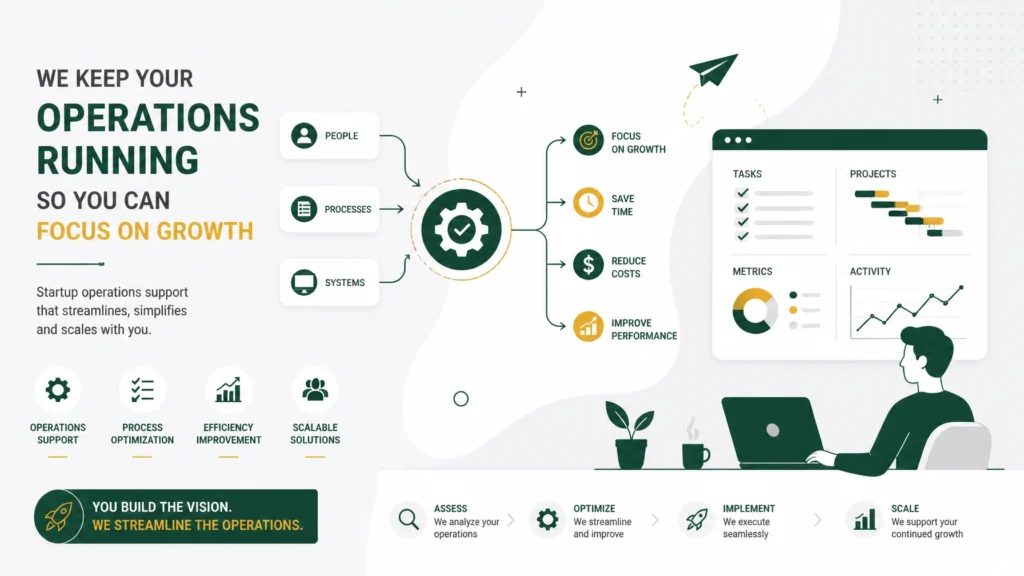
Streamlining business operations isn’t about buying more software tools or adding more project management boards to your stack. In fact, most teams already have too many tools and too little discipline.
Effective startup operations support focuses on three foundational shifts:
- Standardized Playbooks over Ad-Hoc Decisions: Every recurring task: from vendor coordination to weekly reporting: needs a defined, repeatable standard operating procedure. If it isn't documented, it's trapped in someone's head.
- Systemic Coverage over Single-Point Dependency: Relying on one solo virtual assistant creates a new bottleneck when they take time off. Real ops support utilizes structured pods that guarantee continuous coverage without gaps.
- Seamless Tool Integration: Your back-office needs to fit into your existing ecosystem: whether that’s Notion, Slack, or email: without forcing your team to learn yet another proprietary dashboard.

Why Lean Teams Across Southeast Asia and Australia Are Making the Switch
For fast-growing startups, lean teams, and solo founders across regions like Southeast Asia and Australia, hiring a full-time, in-house operations manager early on is financially inefficient. The overhead is too high.
Conversely, relying on unmanaged freelancers introduces unacceptable variance in quality.
This is why structured operations support has become the secret weapon for lean scaling. By plugging in a dedicated, pre-managed ops pod, you get enterprise-grade execution without the administrative drag of full-time hiring or freelancer management.
Whether you are debating between a fractional operations manager or a virtual assistant, the core realization remains the same: you shouldn't be the glue holding your company's backend together.
Penny’s Perspective
"I’ve watched brilliant founders spend ten hours a week arguing with invoice formatting while their market share slipped away to competitors who were actually building product. You didn't start a company to become a glorified data-entry clerk. Stop paying yourself minimum wage for tasks a standardized ops pod can run effortlessly in its sleep. Plug it in, step back, and get back to work."

Taking the First Step to Reclaim Your Time
If you suspect your current operational setup is leaking time and energy, don't wait until burnout forces your hand. Take a moment to evaluate your workflows with our free ops audit tool to identify where your cognitive load is highest.
Operations shouldn't feel like a relentless, grinding chore. It should be a quiet, invisible engine humming reliably in the background.

How many hours of your week are you currently sacrificing to administrative background processing, and what would your company look like if you recovered every single one of them starting tomorrow?
{“@type”:”BlogPosting”,”author”:{“name”:”Dayaly Ops”,”@type”:”Organization”},”@context”:”https://schema.org”,”headline”:”How Startup Operations Support Saves Lean Teams From the 80-Hour Grind”,”publisher”:{“url”:”https://dayalyops.com”,”name”:”Dayaly Ops”,”@type”:”Organization”},”description”:”Discover how startup operations support and streamlining business operations eliminates the ops grind for lean teams without full-time overhead.”,”mainEntityOfPage”:{“@id”:”https://dayalyops.com/blog/startup-operations-support-saves-lean-teams”,”@type”:”WebPage”}}