Fractional Operations Manager vs. Operations as a Service: Which Is Better for Your Startup?
You wake up. You check your email. You glance at Slack.
By 9:00 AM, your brain is already a frantic switchboard. You are triaging vendor disputes, chasing an invoice that’s three days late, and trying to remember if you ever approved that new onboarding flow. You are the founder. You are the CEO. Yet, you spend 70% of your day playing professional "Whac-A-Mole" with administrative fires.
It is a specific kind of exhaustion. You are busy, but you aren't building. You are moving, but your business is standing still.
This is the Ops Tax. It is the invisible fee you pay in focus, energy, and growth every time you handle a task that doesn't require your specific genius.
You know you need help. You know you need to scale. But you are stuck at a crossroads. Do you hire a Fractional Operations Manager to own the mess? Or do you plug in Operations as a Service (OaaS) to dissolve the mess entirely?
The choice you make will either clear your plate or just give you a different kind of plate to spin.
The Fractional Operations Manager: The Part-Time Architect
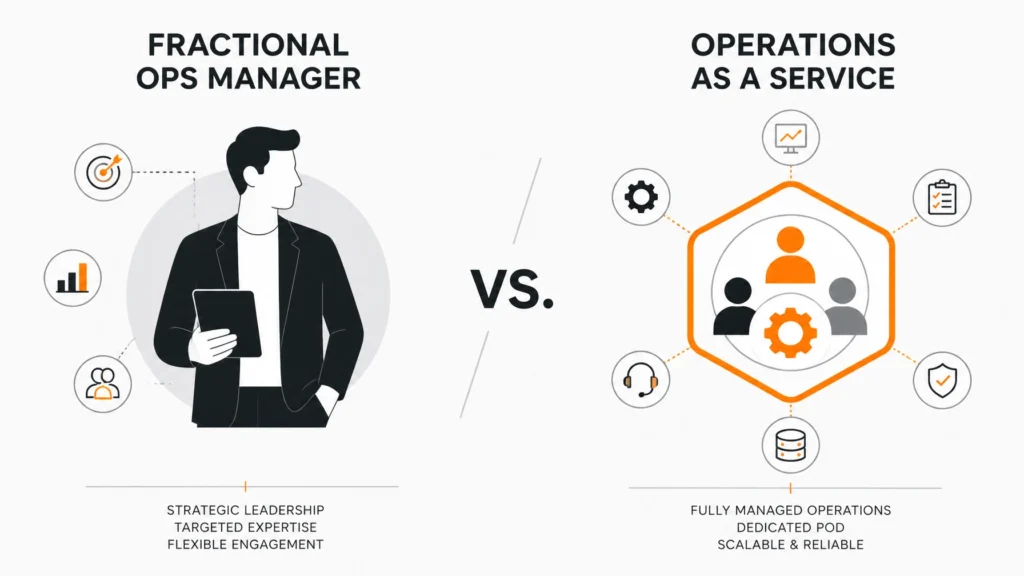
The Fractional Operations Manager (FOM) is a common choice for lean teams. They are a strategist. They are a senior leader who steps into your business for 10 or 20 hours a week to "figure things out."
They look at your messy spreadsheets. They design a new SOP. They attend your leadership meetings. They act as a part-time architect for your internal infrastructure.
But here is the trap.

Hiring a person: even a brilliant, part-time person: comes with management debt. You still have to manage them. You have to onboard them. You have to worry about their "mental residue" from their four other clients.
If they get sick, your operations stop. If they find a full-time gig elsewhere, your systems walk out the door with them. A Fractional Ops Manager gives you leadership, but they don't necessarily give you execution. They might tell you how to fix the invoice process, but you (or your junior staff) still have to do the clicking.
You are delegating the thinking, but you aren't removing the load.
Operations as a Service: The Plug-and-Play System
Operations as a Service: like what we provide at Dayaly Ops: is a fundamentally different mental model.
It is not a person; it is a pod.
Imagine a ready-to-install remote operations team. They don't just give you a strategy; they bring the tools, the people, and the playbooks with them. They are already trained. They are already managed. They integrate into your Notion, your email, and your existing tools overnight.
This isn't about hiring a new team member. It's about installing a utility.

The Management Trap: Delegation vs. Removal
The biggest distinction between these two models is the difference between delegation and removal.
- Delegation is handing a task to someone else and checking in to make sure they did it. It reduces the work but increases the management overhead. You are still the "Chief Firefighter," you just have a part-time deputy.
- Removal is when the function itself becomes a background process. You don't manage the person; you manage the outcome.
When you hire a Fractional Ops Manager, you are adding a node to your communication graph. More meetings. More updates. When you use an OaaS pod, you are shrinking the graph. The pod manages itself. They follow standardized playbooks. If one person in the pod is away, the system continues.
You don't worry about coverage. You don't worry about hiring. You focus on building.
Which Is Better for Your Startup?
There is no one-size-fits-all, but there are clear signals for each.
Choose a Fractional Operations Manager if:
- You need high-level strategic pivots every week.
- You want someone to sit in executive board meetings and help raise your next round.
- You have an existing large team of 20+ people who just need a part-time "boss."
- You are okay with the risk of a single point of failure.
Choose Operations as a Service (OaaS) if:
- You are a lean, fast-growing team (1–15 people) that needs hands-off reliability.
- You are tired of the "hiring-training-churn" cycle of VAs or freelancers.
- You want a fixed monthly cost without the overhead of benefits or equity.
- You want to stop "managing" and start "monitoring."
Note: If you're still debating between a manager and a basic assistant, check out our guide on Fractional Ops vs. Virtual Assistants.
The High Cost of the "Internal Build"
Many founders think, "I'll just hire a Fractional Manager and have them build a team for me."
This is building the machine while trying to drive the car.
It takes months. It involves recruiting, interviewing, training, and documentation. During those months, the Ops Tax continues to drain your bank account and your sanity.
OaaS bypasses the build. It is "Day 1" operational excellence. It is the difference between building a power plant and just plugging into the grid.

From "Who" to "How"
The shift from a Fractional Manager to a managed service is a shift in your identity as a founder.
It is moving from asking, "Who can I find to do this?" to asking, "How can I make this disappear?"
Operational excellence isn't found in a person's LinkedIn profile. It is found in the reliability of a system. It is found in the silence of a Slack channel where things are simply getting done without your intervention.
The High-Stakes Question
As you look at your calendar for next week, count the hours you will spend on admin, inbox management, and vendor coordination.
Then, ask yourself this: If you could buy back those hours today, what would you build with them?
The cost of your current behavior isn't just the money you're spending. It's the product you aren't shipping. It's the vision you aren't articulating. It's the growth you're leaving on the table because you're too busy managing the "grind."
If you’re ready to see how much of your "Ops Tax" you can reclaim, you can start with a free Ops Audit.
Stop hiring people to manage your mess. Start installing systems that eliminate it.

{“@type”:”BlogPosting”,”image”:[“https://cdn.marblism.com/FQ7Jl0oUIhW.webp”,”https://cdn.marblism.com/4NbQrYERr0h.webp”,”https://cdn.marblism.com/wnFL_h04-5X.webp”,”https://cdn.marblism.com/7Ce0GLs1pEq.webp”],”author”:{“url”:”https://dayalyops.com”,”name”:”Dayaly Ops”,”@type”:”Organization”},”@context”:”https://schema.org”,”headline”:”Fractional Operations Manager vs. Operations as a Service: Which Is Better for Your Startup?”,”publisher”:{“logo”:{“url”:”https://cdn.marblism.com/q5oWQVhidpy.webp”,”@type”:”ImageObject”},”name”:”Dayaly Ops”,”@type”:”Organization”},”description”:”Compare Fractional Operations Managers vs. Operations as a Service (OaaS) for your startup. Learn why system-based operations beat traditional delegation for lean, fast-growing teams.”,”datePublished”:”2026-07-10″,”mainEntityOfPage”:{“@id”:”https://dayalyops.com/fractional-operations-manager-vs-operations-as-a-service”,”@type”:”WebPage”}}