Why Making Money Doesn’t Always Mean Having Money
Sep 2026
On 23 September, we hosted a small group of business owners in Kuala Lumpur for a session called “Making Money vs. Having Money.” The premise was simple: your revenue can look completely healthy, and your bank account can still disagree with it. We wanted to talk about where that gap actually comes from, and what closes it.
This isn’t only a Malaysians problem, or a small business problem, or an industry-specific problem. It’s one of the most common and least-discussed traps in running any company that sells on terms. Here’s what the data says, and what we covered.
The Gap Has a Shape
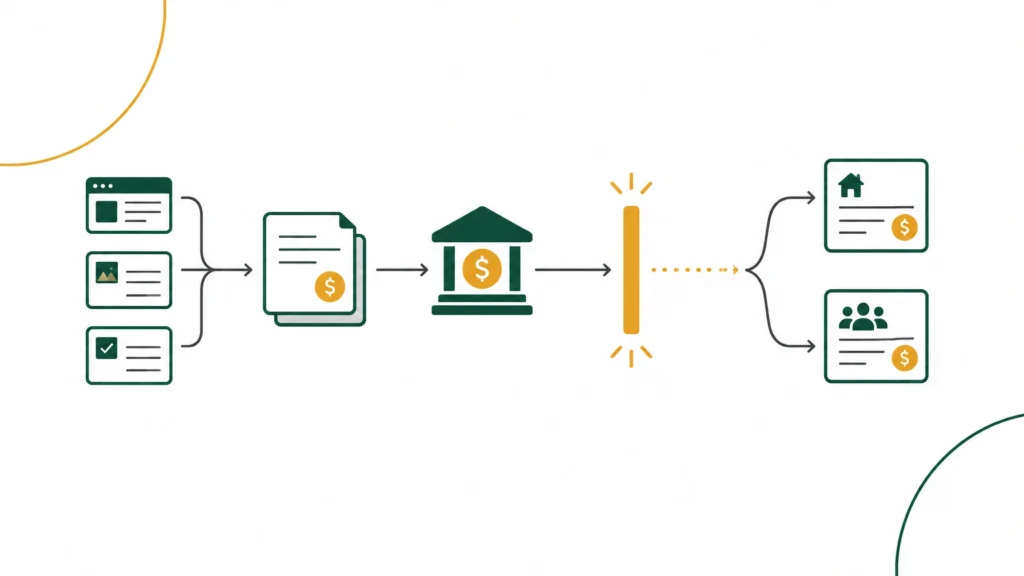
It goes like this, everywhere, in every market:
- You do the work. Product delivered, service completed.
- You send the invoice. On paper, you’re paid. The sale is booked.
- Your customer takes their time. Often weeks, sometimes months, pass before the payment lands.
- Your bills don’t wait. Rent, payroll, and suppliers are due regardless of where step 3 is.
A business can look completely healthy on revenue and still feel broke in practice. That’s not a contradiction — it’s just what happens when the thing you measure (revenue) and the thing you can actually spend (cash) are allowed to drift apart for long enough.
How Big Is the Gap?
This is where it stops being a feeling and starts being measurable. A few figures, from a few different markets, all pointing at the same thing:
- ~64 days — the average payment delay for Malaysian SMEs, which has barely moved in four years, per Experian Malaysia’s State of Credit 2025 report and the Malaysian Micro Business Association (Mamba).
- Up to 120 days — how long some micro-businesses wait to get paid for work already delivered.
- 26 days — how much longer Malaysian SMEs wait for payment than large corporates do, in transport and logistics alone.
- 82% of business failures involve cash flow problems, according to a widely cited U.S. Bank study (via SCORE). It’s an older figure and worth treating as directional rather than exact, but it’s been remarkably consistent across the years it’s been re-cited — which says something on its own.
- Roughly 50,000 UK businesses close every year specifically because of late payments, according to the UK’s Federation of Small Businesses.
Different countries, different currencies, same underlying pattern: the business earned the money before it could actually use it, and the gap in between is where things go wrong.
It’s Not the Late Payment. It’s the Chasing
Here’s the part that doesn’t show up in any of those statistics: the actual cost isn’t the delay itself. It’s what the delay demands of you personally.
In most small businesses, only the owner reliably remembers who owes what, when it’s due, and when to follow up.
A simple follow-up cadence can be of help -> three days before due, on the due date, three days overdue, then escalate
but having a cadence and actually running it, every time, for every invoice, are two different things.
Why “Just Use an App” Doesn’t Solve It
The obvious fix looks like software. An automated reminders, a cleaner dashboard, one-click follow-ups. And for some businesses, that’s genuinely enough.
But in our own market research, we spoke with a business owner managing around 200 customer invoices by hand. She’d been pitched a billing app with automated reminders and chose not to use it. Not because it didn’t work. Because handing over her customer list and her money flow to a tool she didn’t fully trust felt riskier than the manual chasing she already knew.
That’s not an isolated reaction. 47% of Malaysian SMEs cite data security and privacy as a top barrier to adopting new financial software, according to Xero’s “E-Invoicing Readiness Among SMEs in Malaysia” whitepaper (2025). The barrier isn’t the technology itself.
It’s trust and time.
Which means the fix isn’t automatically “more software.” Sometimes it’s a person or a team that already has that trust built in or has nothing to leak in the first place, because they’re not selling you a platform. They’re doing the work.
The Fix
This isn’t theoretical for us. We run this kind of back-office coordination for PT Bangun Pangan Indonesia (BPI), an agri-inputs company selling nano-tech crop products to plantations and farmer groups across Indonesia. The follow-ups, documentation, and admin that would otherwise compete with the actual work of running the business.
What Closing the Gap Looks Like, Step by Step
At the session, we walked through the actual system — not a vague promise, an acronym simple enough to run without a new dashboard. We call it SENT → PAID:
SENT:
- Scan — review invoices and aging
- Evaluate — rank by value, age, and collectability
- Nudge — run professional, multichannel follow-up
- Track — record every response and commitment
PAID:
- Pursue
- Agree
- Invoice check
- Document
It’s not complicated on purpose. The point isn’t to impress anyone with the process. It’s to make sure the process actually happens, every single cycle, without depending on the founder’s memory to trigger it.
What Three Months of This Actually Looks Like
Not a pitch deck promise — a realistic timeline of what changes, and when:
- By 30 days — Clarity. Invoices are out. Payments are coming in. You get your first clear morning report instead of reconstructing the picture from memory.
- By 60 days — Peace of mind. Compliance deadlines are tracked. Vendors are paid on time. You stop checking your phone every five minutes for a payment notification.
- By 90 days — The dream returns. You’re back to the reason you built the business in the first place. You’ve got your time back. You’re building, not just surviving.
Why We Ran This Session
The businesses we work best with aren’t the ones who need convincing that this gap exists. They already feel it. They just haven’t had a system that closes it without asking them to trust a platform with their entire customer list, or hire someone new to manage.
That’s the whole idea behind Dayaly Collect is:
you give us your list of unpaid invoices and customer contacts, we chase them across WhatsApp, email, and phone until the money lands or the account hits a clear escalation point, and everything syncs back into the tools you already use.
Money lands directly in your own account while you can just focus on making another profit.
Got invoices sitting overdue right now? Book a 30-minute discovery call, or visit dayalyops.com to see how we works.
Dayaly Ops · PT Katalis Daya Insani · Jakarta, Indonesia